Restorative & Advanced Care
Advanced Procedures
Some problems are too big for a filling and cleaning. When a tooth is badly infected, cracked, worn down, or missing altogether, this is the care that saves what can be saved and rebuilds what can't: root canal treatment, crowns, bridges, and dentures. Below is what each one actually involves, plainly explained.
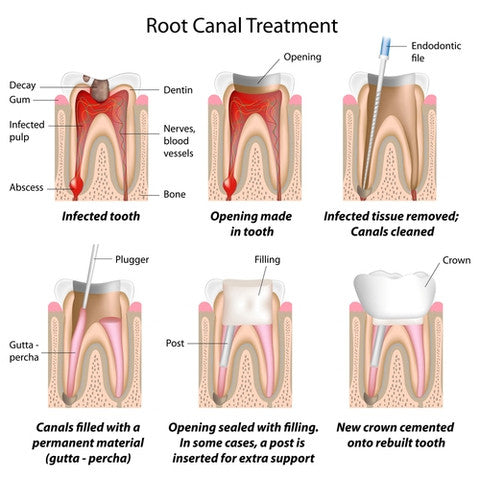
A throbbing, infected tooth doesn't have to be pulled
A cavity that's gone untreated (or a deep filling or injury) can work its way down into the nerve at the center of the tooth. Once that inner pulp is infected it cannot heal on its own. Left alone, the infection can spread through the root tip into the surrounding bone, forming an abscess. Watch for sensitivity to hot, cold, or sweets, pain when you bite down, swelling, or a bad taste in your mouth. Sometimes there are no symptoms at all until we spot it on a checkup, which is exactly why regular exams catch it early.
Root canal treatment clears out the infected pulp, disinfects the canals inside the tooth, and seals them so the infection can't return. The alternative is extraction, so a root canal is what lets you keep your natural tooth. Most root canals are finished with a core build-up and a crown on top, since the tooth needs that extra protection afterward.
Endodontic (root canal) therapy, typically followed by a core build-up and crown.
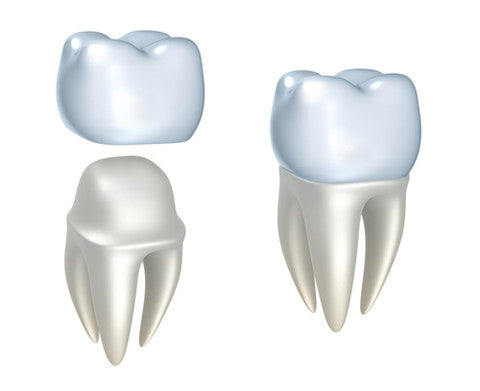
Need a crown? Plan on two visits, not a rushed one
A crown is a full-coverage cap that goes over a tooth that's too broken down for a filling to hold, or one that's likely to crack under normal biting force, since your jaw muscles are the strongest in your body, and teeth take real pressure every day. Crowns are most often needed after root canal treatment or when a large filling finally wears out and the tooth underneath is too weak to trust with just a patch.
At your first visit we remove any remaining decay, shape the tooth to accept the crown, and take an impression to send to the lab. You wear a temporary crown while your permanent one is fabricated, usually in high-strength porcelain over a gold alloy, all-ceramic material, or gold, depending on where the tooth sits and how much strength or natural appearance matters most. At your second visit the temporary comes off, the permanent crown is adjusted to fit your bite exactly, and it's cemented in place.
Crowns in porcelain-over-gold, all-ceramic, or gold, fitted over two appointments.
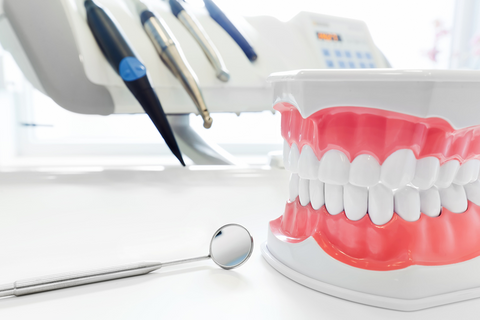
Loose or lost teeth don't mean giving up eating and talking normally
Dentures replace teeth that have loosened or fallen out because of bone loss around the roots. Once that bone loss is severe enough, the affected teeth can't be saved. We examine the whole mouth first to determine which teeth have to come out and which can stay, then extract the loose teeth and fit the denture to go over or around whatever teeth remain, depending on the type you need.
There's an adjustment period while you get used to a denture in your mouth, which is completely normal. Once you're accustomed to it, normal eating, talking, and smiling come back. Implants can also be used to further stabilize a denture that needs extra hold.
Full and partial dentures, made with our own in-house lab. See our same-day process on the Dentures in a Day page.
See denture pricing and same-day fitting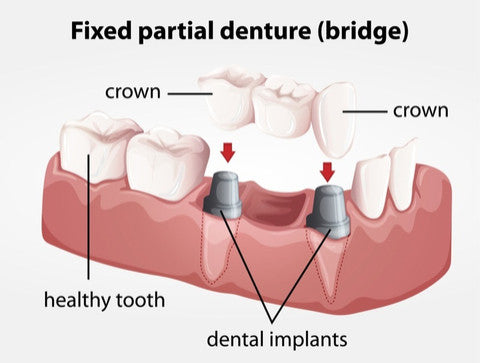
A missing tooth leaves a gap that can throw off your whole bite
A bridge fills the space left by a missing tooth with a replacement shaped to look and function like the tooth that was there, anchored on the two surrounding teeth for support (that's where the name comes from). It restores both the way you chew and the way your smile looks. Bridges are made in gold alloys, porcelain bonded to metal, or all-ceramic material, chosen based on how much strength, wear resistance, or natural appearance the spot calls for.
Timing matters more than most people realize. Leave the gap open and the teeth next to it start to lean and drift inward, because teeth lean on their neighbors for support and one going missing sets off a chain reaction. As neighboring teeth shift, your bite changes to compensate, which over time can strain the jaw joint itself. The teeth that drifted out of position get harder to keep clean, so gum disease sets in around them, and the longer it's left, the more of those teeth end up at risk too. Replacing the missing tooth promptly is what stops that chain reaction before it starts.
Fixed bridges in gold alloy, porcelain-fused-to-metal, or all-ceramic material.
Before a denture or bridge
If a tooth has to come out first
Root canals, crowns, and bridges are about saving or replacing one tooth. Sometimes the honest answer is that a tooth needs to come out before we can move forward with a denture or partial. Here's what a couple of the most common extraction fees look like, pulled from our fee schedule.
| Item | Price |
|---|---|
| Simple extraction, without prosthetics | $115.00 |
| Simple extraction, with prosthetics | $99.00 |
| Surgical extraction, with prosthetics | $150.00 |
All prices are approximate and cannot be guaranteed until a complete exam and X-ray are completed. See the full itemized price list for alveoloplasty, relines, and full denture pricing.
Not sure what you need?
Call and describe what's bothering you
Pain, a sensitive tooth, a chip, a loose tooth, or a gap you've been meaning to deal with, tell us what's going on and we'll tell you plainly whether it's a filling, a crown, a root canal, a bridge, or a denture, and what it costs before you're in the chair.
Also see everyday dental health services for cleanings, fillings, and gum treatment, or Dentures in a Day for same-day denture pricing and our in-house lab.